
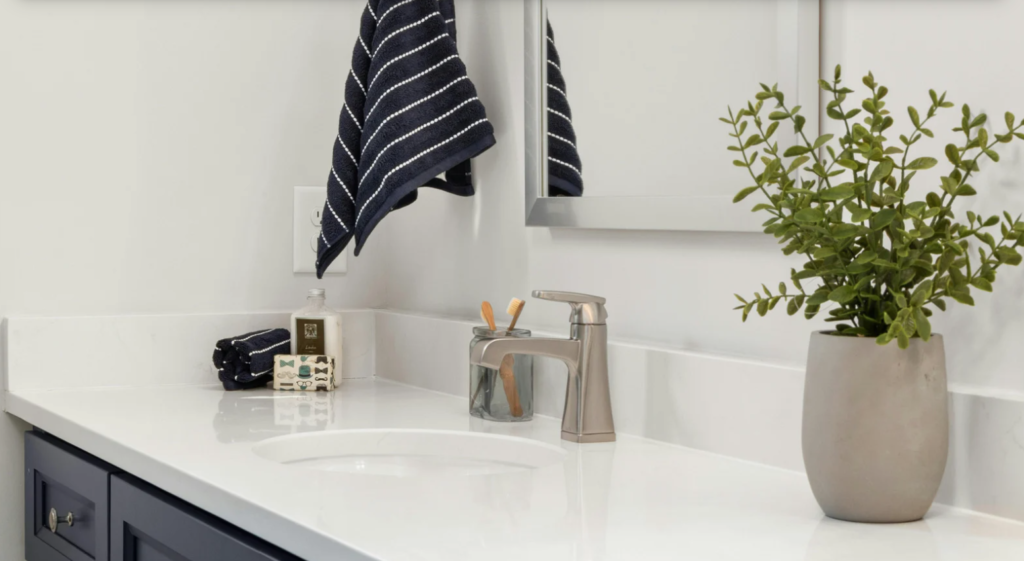
What Makes a Bathroom Vanity Right for a Florida Home?
The best bathroom vanity for a Florida home combines moisture-resistant construction, the correct size for the room, practical storage, a durable countertop, and hardware that can tolerate a humid environment. In Tampa, vanity selection should not be based on appearance alone. Bathrooms regularly experience steam, condensation, splashes, and high ambient humidity, so cabinet materials, finishes, ventilation, and installation quality directly affect how well the vanity holds up.
A vanity is one of the most used pieces in a bathroom. It supports the sink, stores daily essentials, influences circulation, and often becomes the visual anchor of the entire room. Choosing it early also helps coordinate plumbing, lighting, mirrors, outlets, and countertop fabrication.
If your vanity is part of a larger project, review our complete bathroom remodeling guide for Tampa homeowners before locking in finishes. The vanity should support the overall renovation plan rather than becoming an isolated purchase.
Best Bathroom Vanity Materials for Florida Humidity
Material quality matters more in Florida than in a dry interior climate. Tampa experiences long periods of high humidity, and recent National Weather Service observations regularly show average relative humidity in the 70% range or higher during summer periods. That does not mean every bathroom cabinet will fail, but it does mean poorly sealed materials have less margin for error.
For cabinet boxes and doors, plywood construction is often a strong choice because it generally handles moisture exposure better than low-grade particleboard. High-quality furniture-grade MDF can also perform well when properly sealed and used in a well-ventilated bathroom, but exposed edges and repeated water contact should be avoided.
Solid wood can work beautifully, but it naturally expands and contracts with humidity changes. Proper finishing on all sides is important. Engineered cabinet doors may offer more dimensional stability than large solid-wood panels, especially in bathrooms with frequent showers.
| Material | Humidity Performance | Best Use |
|---|---|---|
| Quality plywood | Very good when sealed properly | Primary and guest bathrooms |
| Furniture-grade MDF | Good when fully finished and protected | Painted doors and contemporary vanities |
| Solid wood | Good with proper finishing and ventilation | Custom and furniture-style vanities |
| Low-grade particleboard | Poor if water reaches exposed edges | Budget applications with limited moisture exposure |
How to Choose the Right Vanity Size
Vanity width should match both the room and the way the bathroom is used. Common widths include approximately 24, 30, 36, 48, 60, and 72 inches, but the largest vanity that physically fits is not always the best choice.
Start with circulation. Make sure doors, drawers, shower glass, bathroom doors, and toilet clearances can function without conflict. A vanity that crowds the toilet or blocks a comfortable path can make a newly remodeled bathroom feel smaller than the original.
For a powder room or compact guest bath, a 24- to 36-inch vanity may be enough. A 48-inch vanity gives one user more counter space and storage. Primary bathrooms often benefit from 60- to 72-inch vanities, especially when two sinks are needed.
Small bathrooms require more discipline. If you are working with limited square footage, see our small bathroom remodel ideas for Tampa homes for ways to preserve storage without sacrificing movement.
Floating vs Freestanding Bathroom Vanities
Both floating and freestanding vanities can work well in Florida homes. The better choice depends on the room, desired style, wall construction, storage needs, and cleaning preferences.
A floating vanity is mounted to the wall and leaves the floor visible underneath. This can make a smaller bathroom feel more open and makes floor cleaning easier. It also creates a modern, architectural look. However, the wall must be properly reinforced to carry the load, especially with a heavy countertop.
A freestanding vanity sits on the floor and can offer more traditional proportions and straightforward installation. Furniture-style legs can add character, while full-to-floor bases maximize storage. In either case, the bottom of the cabinet should not sit in standing water or repeated shower overspray.
| Feature | Floating Vanity | Freestanding Vanity |
|---|---|---|
| Visual effect | Open and modern | Traditional or furniture-like |
| Cleaning | Easy access underneath | Depends on toe-kick or legs |
| Installation | Requires solid wall support | Typically simpler structurally |
Choose a Countertop That Handles Daily Bathroom Use
Bathroom countertops deal with water, toothpaste, cosmetics, hair products, cleaning chemicals, and repeated wiping. Quartz is a popular choice because it is nonporous, consistent, and low maintenance. Porcelain slabs can also perform very well and offer strong resistance to moisture and staining.
Natural stone such as marble can create a luxury look, but it needs more care. Marble is more susceptible to etching and staining than engineered quartz or porcelain, so homeowners should be comfortable with the maintenance requirements before choosing it for a heavily used vanity.
Countertop selection should also coordinate with the shower and wall finishes. If you are comparing natural stone and porcelain elsewhere in the bathroom, our guide to marble versus porcelain bathroom tile in Tampa explains the durability and maintenance tradeoffs.
Plan Storage Around How You Actually Use the Bathroom
A vanity should reduce countertop clutter, not create more of it. Before choosing drawers and doors, think about what needs to live inside the cabinet every day: hair tools, towels, cosmetics, cleaning products, extra toiletries, medication, grooming devices, and toilet paper.
Deep drawers are often more useful than large open cabinets because items can be seen from above instead of disappearing behind plumbing. U-shaped drawers can wrap around sink plumbing and recover storage that would otherwise be lost.
For double vanities, symmetry is not mandatory. One side can hold grooming tools while the other stores towels or toiletries. The best interior layout is the one that reflects how the bathroom is used, not the one that looks most symmetrical in a catalog.
Coordinate the Vanity With Plumbing, Faucets, Mirrors, and Lighting
One of the most common bathroom planning mistakes is selecting the vanity after plumbing and electrical locations are already fixed. Vanity width and sink position affect drain locations, water supply lines, outlet placement, sconces, mirrors, and countertop fabrication.
If you choose a wall-mounted faucet, the rough plumbing must be positioned precisely before the wall is closed. Vessel sinks change counter height and faucet dimensions. A double vanity may require additional plumbing adjustments if the existing bathroom was designed for only one sink.
Mirror size and lighting should be planned at the same time. A beautiful 72-inch vanity can look unbalanced with an undersized mirror or poorly placed sconces. The design should be resolved as a system.
For homeowners planning a complete renovation, our guide on what to expect during a full bathroom renovation shows when plumbing, electrical, waterproofing, tile, and finish installation typically happen.
How Much Should You Budget for a Bathroom Vanity?
Vanity pricing can range from a few hundred dollars for a small stock cabinet to several thousand dollars for a large custom unit with premium hardware, stone countertops, integrated storage, and specialty finishes. For many Tampa renovations, a complete vanity area including cabinet, countertop, sink, faucet, and installation can represent a meaningful portion of the bathroom budget.
If you are deciding where to spend more, prioritize the cabinet box, hardware, countertop, and installation quality before decorative extras. Soft-close hinges and drawer slides, properly sealed finishes, durable edge details, and a well-fitted countertop all affect everyday performance.
The vanity should also make sense within the total project budget. Review our guide to bathroom remodel costs in Tampa before allocating too much of the renovation budget to cabinetry alone.
Common Bathroom Vanity Mistakes to Avoid
The first mistake is buying by width alone. Homeowners sometimes verify that a 60-inch vanity fits a wall but forget to account for door swings, drawers, toilet clearances, trim, or plumbing locations.
The second mistake is choosing a material without considering moisture. A cabinet that performs well in a bedroom may not be the right choice next to a shower that is used twice a day.
The third mistake is leaving countertop, faucet, sink, and mirror decisions until late in the project. These items are connected. Changing one can force changes to plumbing, lighting, fabrication, or installation.
The fourth mistake is sacrificing storage for appearance. A highly stylized vanity may photograph well but become frustrating if it cannot hold the items used every morning.
At Nexus Design, our crews install cabinetry, tile, plumbing-adjacent finish work, flooring, and complete bathroom renovations across Tampa homes. Because the work is handled by our own team rather than passed through layers of subcontractors, we see how vanity decisions affect the rest of the room in real installations, not just on paper.
Frequently Asked Questions About Bathroom Vanities in Florida
What is the best bathroom vanity material for Florida humidity?
Quality plywood is one of the safest choices for bathroom vanity construction because it generally handles moisture better than low-grade particleboard. Furniture-grade MDF and solid wood can also perform well when properly sealed, installed correctly, and used in a bathroom with effective ventilation.
Is a floating vanity better in a humid bathroom?
A floating vanity can be helpful because it keeps the cabinet off the floor and makes cleaning easier, but it is not automatically more moisture resistant. Material quality, sealing, ventilation, and proper wall installation still matter more than mounting style alone.
What vanity size works best for a primary bathroom?
Many primary bathrooms use vanities in the 60- to 72-inch range, especially when two sinks are needed. The correct size depends on wall length, circulation, storage needs, plumbing positions, and clearances around the shower, toilet, and bathroom door.
Should I choose the vanity before starting a bathroom remodel?
Yes. Selecting the vanity early helps coordinate plumbing, electrical outlets, lighting, mirrors, sink placement, countertop fabrication, and overall room layout. Waiting until late in construction can create avoidable changes and delays.
At Nexus Design, we only recommend what actually works. Our crews install flooring, remodel kitchens and bathrooms, and renovate outdoor spaces daily across residential projects — we know which materials hold up and which ones fail in high-humidity environments. That field experience is what guides every recommendation we make.