
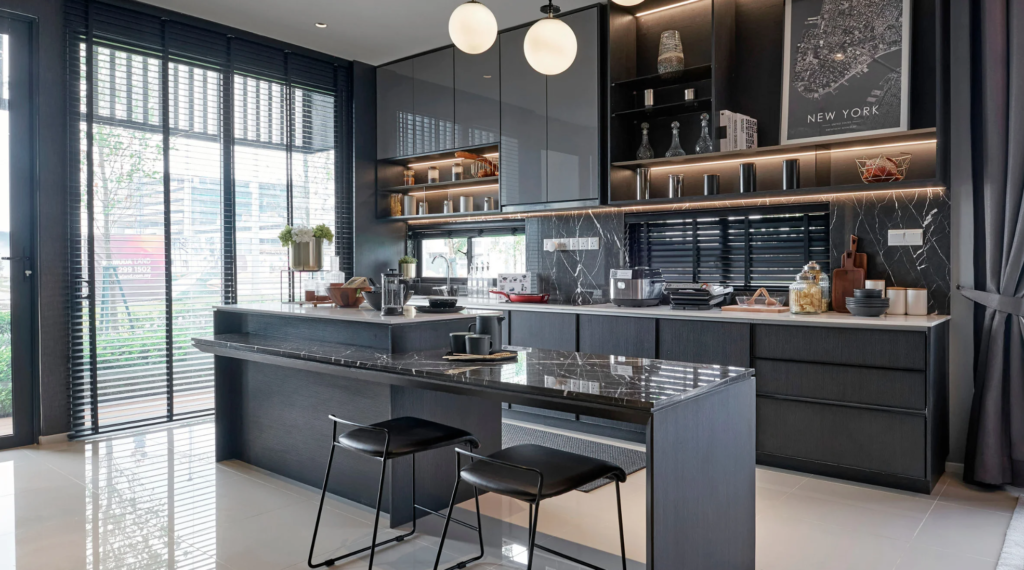
1. Two-Tone Cabinetry
Two-tone cabinetry — different colors on upper and lower cabinets, or a contrasting island color against perimeter cabinets — has moved from a niche design choice to a mainstream preference in Tampa kitchen remodels. In 2026, it’s one of the most requested cabinet treatments in the market.
The most common combination is white or light upper cabinets paired with a deeper lower cabinet — navy, forest green, charcoal, warm gray, or sage. The visual effect grounds the kitchen without making it feel heavy, and the lighter uppers maintain an airy quality that works well in Florida’s bright interior environments.
A variation of this trend uses a contrasting color only on the island — a colored or wood-tone island against all-white perimeter cabinetry. This is particularly effective in open-plan Tampa homes where the island is the visual focal point of the kitchen from the living area.
Longevity assessment: Two-tone cabinetry is built on a sound design principle — contrast and visual depth — so it has more staying power than trendy colors alone. The specific color combinations will evolve, but the approach of differentiating island or lower cabinets from upper cabinets is likely to remain relevant.
For guidance on choosing cabinet styles and finishes for Florida’s climate specifically, our guide on how to choose kitchen cabinets for a Florida home covers material durability alongside design considerations.
2. Fluted and Textured Surfaces
Fluted panels — vertical ridges applied to cabinet ends, island faces, or range hood surrounds — have emerged as one of the defining visual details of the current kitchen design era. They add dimension and tactile interest to surfaces that are typically flat, and they work across a range of styles from modern to transitional to coastal, which makes them particularly relevant in Tampa’s design culture.
Fluting appears most commonly on island end panels and as a detail on the range hood column or surround. It’s a design choice that photographs exceptionally well and creates a custom-built feeling without requiring true custom millwork throughout the kitchen.
Beyond fluting, textured backsplash tile — handmade-look ceramics, dimensional tile with relief patterns, and zellige-style tiles with irregular surfaces — are replacing the large-format subway tile that dominated the previous decade. These tiles bring warmth and character to the kitchen’s vertical surfaces in a way that flat tile doesn’t.
Longevity assessment: Texture as a design principle is enduring. The specific expressions of it — fluting today, something else tomorrow — will evolve, but the preference for surface interest over stark flatness reflects a broader shift in interior design that has momentum.
3. Integrated and Panel-Ready Appliances
Integrated appliances — refrigerators and dishwashers with cabinet panel fronts that blend seamlessly into the cabinetry — have transitioned from a luxury-only feature to a mainstream kitchen design goal in Tampa. The look is clean, uninterrupted, and increasingly achievable without a luxury appliance budget.
Panel-ready appliances accept custom cabinet panels fabricated to match the kitchen’s cabinetry, so the refrigerator and dishwasher disappear into the wall of cabinets. The result is a kitchen that looks like a unified piece of furniture rather than an assemblage of appliances and cabinetry.
Counter-depth refrigerators — which don’t protrude past the cabinet line — are part of this same trend. They sacrifice some interior storage volume in exchange for a streamlined profile that makes the kitchen feel less cluttered and more intentional.
Longevity assessment: The preference for clean, integrated aesthetics is deeply rooted in contemporary design values and is unlikely to reverse. This trend has been building for years and continues to accelerate as panel-ready options become more accessible at mid-range price points.
4. Statement Range Hoods
The range hood has become the kitchen’s architectural moment — a design feature as much as a functional element. In 2026 Tampa kitchens, range hoods are being designed as focal points: plaster-finished custom hoods with sculptural profiles, wood-clad hoods that bring warmth to contemporary kitchens, and geometric metal hoods that contrast with surrounding cabinetry.
This trend is particularly well-suited to open floor plans where the range and hood are visible from across the entire living space. A well-designed range hood anchors the kitchen visually and gives the space a finished, intentional quality that a standard builder-grade insert hood never achieves.
From a functional perspective, the shift toward statement hoods also corresponds with greater attention to ventilation performance — which matters in Florida kitchens where cooking humidity adds to already-high ambient humidity. A well-sized hood ducted to the exterior is a meaningful quality-of-life improvement beyond aesthetics.
Longevity assessment: The range hood as a design feature has staying power because it solves a real aesthetic problem — the hood is one of the largest objects in the kitchen and ignoring its design always results in a kitchen that feels unfinished. Custom and semi-custom hood designs will continue to evolve, but the emphasis on the hood as a statement piece is here to stay.
5. Warm Natural Materials
After years of cool-toned, white-and-gray kitchen design dominance, Tampa homeowners are moving decisively toward warmer material palettes. Natural wood tones in cabinetry and open shelving, warm-toned stone with golden and amber veining, terracotta and warm-neutral tile, and unlacquered brass hardware are all gaining traction in 2026.
This shift is partly a reaction to the all-white kitchen’s ubiquity — after a decade of the same look, homeowners want something that feels more individual and less mass-produced. It also reflects a broader design preference for warmth and lived-in character over sterile precision.
In Tampa’s coastal context, warm materials align naturally with the environment — warm light, tropical landscaping, outdoor living culture all point toward a design vocabulary that incorporates wood, stone, and natural textures rather than fighting them with stark industrial aesthetics.
Longevity assessment: This trend reflects a genuine shift in taste rather than a surface fad. Warm, natural material palettes have deep roots in design history and tend to age well. Kitchens built around warm neutrals and natural materials in 2026 are less likely to feel dated in 2031 than those built around cool grays and stark whites were in the same five-year span.
Which Trends Will Last — and How to Apply Them
Not every trend deserves equal investment. A good rule for incorporating kitchen design trends into a remodel: apply trends in reversible elements (hardware, paint, backsplash tile, lighting fixtures) and invest in timeless choices in expensive, hard-to-change elements (cabinet construction quality, countertop material, flooring).
A navy island can be repainted in five years if the look feels dated. A statement hood can be replastered or refinished. Hardware can be swapped for under $500. But the cabinet boxes, countertop, and flooring will be there for 15–25 years — choose those for longevity and quality, not for what’s trending right now.
Of the five trends above, integrated appliances and warm natural materials are the most foundational — they reflect lasting design preferences rather than moment-specific aesthetics. Two-tone cabinetry and statement hoods are well-designed trends with staying power. Fluted surfaces are the most trend-specific and the most subject to dating — use them as an accent detail rather than a primary design decision if you’re concerned about longevity.
Frequently Asked Questions
Are white kitchens still popular in Tampa in 2026?
White kitchens remain common and are still a safe, broadly appealing choice — especially for resale. But the all-white monochromatic kitchen that dominated 2015–2022 has lost momentum. Warm whites combined with natural wood accents, two-tone combinations, and warmer neutral palettes are replacing the stark cool-white look. White as a component of a kitchen still works well; white as the only color in the space feels increasingly dated.
What countertop color is most popular in Tampa kitchens in 2026?
White and light gray quartz with subtle veining remains the single most popular countertop look in Tampa’s market. Among natural stone, warm-toned quartzite with gold and amber veining is gaining ground. The shift toward warmer palettes is influencing countertop choices alongside everything else — expect cream, greige, and warm white stone with movement to continue growing in popularity through 2026 and beyond.
Should I follow trends when remodeling a kitchen I plan to sell?
Partially. For resale, prioritize broadly appealing choices over personal taste or cutting-edge trends. Neutral, current-feeling design outperforms both very traditional and very trendy kitchens in the Tampa resale market. Warm neutrals, quality quartz countertops, clean cabinet lines, and updated fixtures are a reliable formula for broad buyer appeal. Add trend elements in low-cost, reversible decisions — hardware, lighting — rather than in the permanent structure of the kitchen.
At Nexus Design, we only recommend what actually works. Our teams manage kitchen remodels from concept through completion — with direct crews, no subcontractors, and a process built around clear communication and quality that holds up over time. That’s what makes the difference between a kitchen that looks great on day one and one that still looks great ten years later.