
Why Florida Changes the Cabinet Decision
Cabinet selection is one of the highest-stakes decisions in a kitchen remodel — cabinets represent the largest single cost and the most visible design element in the space. In Florida, those stakes are raised by a climate factor that doesn’t appear on most national cabinet buying guides: humidity.
Tampa’s year-round humidity — averaging above 74% and peaking much higher during rainy season — affects wood-based materials in a kitchen environment where cooking adds additional moisture on top of ambient conditions. Cabinets that would last 20–30 years in the Midwest or Pacific Northwest may show warping, delamination, and drawer joint failures in a Florida kitchen within 5–10 years if the cabinet construction isn’t suited to the environment.
This doesn’t mean you need to compromise on appearance or design. It means you need to understand which construction specifications translate to real durability in Florida conditions — and prioritize those over superficial features like ornate door profiles or decorative glass inserts that look appealing but add no structural value.
Box Material — The Most Important Spec
The cabinet box — the structural carcass that the doors and drawers attach to — is the single most important quality factor in Florida kitchen cabinetry. There are two main materials used for cabinet boxes: plywood and particleboard (also called MDF in some variations).
Plywood boxes are the right choice for Florida homes. Plywood is made from thin layers of wood veneer glued in alternating grain directions, which gives it dimensional stability and resistance to warping when humidity fluctuates. It holds screws well, resists moisture absorption better than particleboard, and maintains its structural integrity over decades in a climate-controlled kitchen environment.
Particleboard boxes are the budget alternative used in most builder-grade and entry-level stock cabinets. Particleboard is made from wood particles and resin — essentially compressed sawdust. It’s significantly more susceptible to moisture than plywood. In a Florida kitchen that cycles between air conditioning and humid outdoor air when windows open or the AC cycles, particleboard boxes swell, warp, and lose their structural integrity faster than in drier climates. Drawer bottoms made of particleboard are particularly vulnerable.
When evaluating cabinets, ask specifically: “Are the boxes plywood or particleboard?” This question is the fastest quality filter available. Many cabinet salespeople and showrooms lead with door style and finish; the box material often requires a direct question to surface.
Stock vs. Semi-Custom vs. Custom
Stock cabinets are manufactured in fixed sizes (typically in 3-inch width increments) and available off the shelf or with short lead times. They’re the most affordable option — $150–$300 per linear foot installed — and the widest range of stock cabinets use particleboard boxes. Some higher-quality stock lines offer plywood boxes; these are worth seeking out even within the stock category. Stock cabinets work for standard kitchen layouts with few unusual dimensions.
Semi-custom cabinets are built to order in a wider range of sizes and configurations than stock, with more options for door style, finish, interior accessories, and box depth. Lead times are typically 4–8 weeks. The quality floor in semi-custom cabinetry is significantly higher than stock — most mid-range and up semi-custom lines offer plywood boxes as standard. Cost: $300–$600 per linear foot installed. This is the most common choice for Tampa kitchen remodels in the $40,000–$80,000 range.
Custom cabinets are built to exact specification by a local or specialty cabinet maker. Every dimension, detail, and finish is specifiable. Lead times run 8–16 weeks. Cost: $800–$1,500+ per linear foot installed. Custom cabinetry makes sense for kitchens with unusual dimensions, design requirements that no manufactured line can meet, or homeowners for whom the kitchen is a long-term investment in premium quality. In Florida, a reputable local custom cabinet maker will know exactly what construction specifications work in the climate.
Door Style and Finish
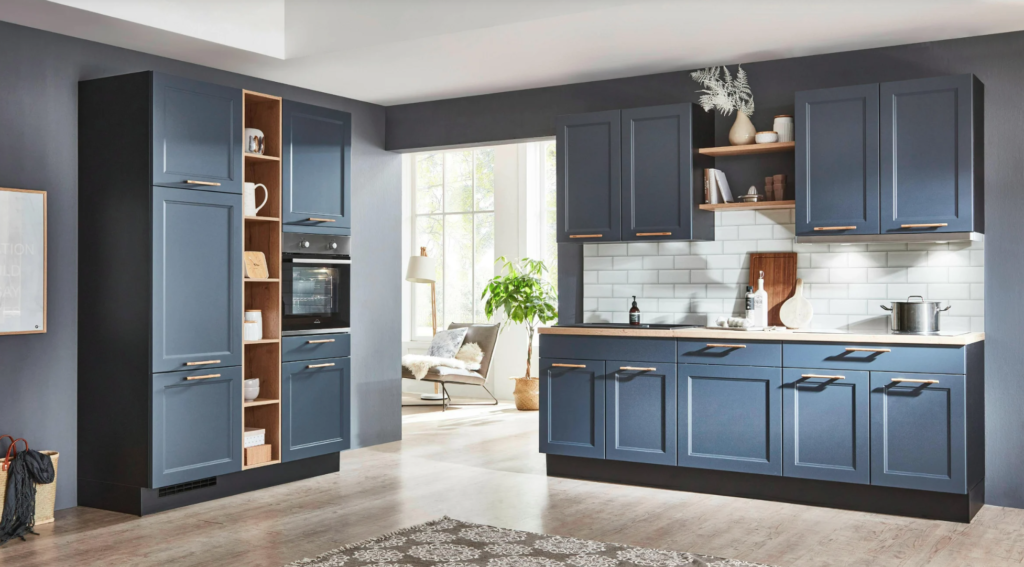
Cabinet door style sets the design tone of the entire kitchen. A few guidelines for the current Tampa market:
Shaker doors remain the dominant choice — clean, versatile, and compatible with everything from traditional to contemporary design. They’re the safe choice for resale and the starting point for most design conversations.
Flat-panel (slab) doors are the choice for contemporary and modern kitchens. They require more precision in installation and finishing because imperfections are more visible without the detail of a raised or recessed panel. In high-humidity environments, flat MDF slab doors can swell at edges over time — solid wood or PVC-wrapped flat panel doors perform better in Florida than painted MDF flat panel doors.
Painted finishes are popular and look beautiful but require more maintenance in Florida. Painted cabinets can show humidity-related finish issues — particularly at door edges and near the range and dishwasher — more readily than stained or natural wood finishes. Using a high-quality paint system with a durable topcoat, and choosing a paint-grade wood (not MDF) door, minimizes this risk.
Thermofoil and laminate door finishes are low-maintenance and moisture-resistant but have a reputation for peeling at edges in high-heat areas near ranges and ovens. In Florida kitchens where cooking adds heat to already-warm conditions, thermofoil near the range is a risk. Use these finishes in lower-risk areas and avoid them directly adjacent to heat sources.
Hardware
Cabinet hardware — pulls, knobs, and hinges — seems like a finishing detail, but it has a disproportionate impact on the kitchen’s feel and on the daily experience of using the cabinets. In Florida, the material of hardware also matters because coastal environments can accelerate corrosion on lower-quality metals.
Choose solid brass, stainless steel, or quality zinc alloy hardware. These materials resist the corrosion and tarnishing that Tampa’s humidity and salt-laden air can accelerate on lower-quality plated hardware. Unlacquered brass — currently trending — will develop a natural patina in Florida’s climate. If you prefer consistent finish, opt for brushed or satin brass instead.
Soft-close hinges and drawer slides are worth the cost. Soft-close mechanisms eliminate slamming, which reduces wear on box joints over time — and in a Florida kitchen where humidity causes minor wood movement, that reduced mechanical stress matters for longevity. Most semi-custom and custom cabinet lines include soft-close as standard; verify this when evaluating stock lines where it may be an add-on.
How to Evaluate Cabinet Quality
When visiting a showroom or reviewing a cabinet specification, these are the quality indicators that matter most for Florida conditions:
Ask about box material — plywood or particleboard. Ask about drawer box construction — dovetail or dowel joints are more durable than stapled joints. Ask about the finish system — number of coats, type of paint or stain, UV-cured or air-dried. Ask about interior finishes — finished interiors (painted or laminated inside the cabinet box) are more durable and easier to clean than unfinished interiors.
Open and close display samples multiple times. Soft-close should feel consistent and controlled, not sluggish or variable. Pull drawers out fully — they should extend smoothly with no binding or side-to-side wobble. Check the interior of drawers for solid joinery at the corners.
Ask for the warranty terms. Quality cabinet manufacturers stand behind their product with meaningful warranties — 5 years on finish, lifetime on box and drawer construction. Be cautious of cabinets with minimal or unclear warranty language.
Frequently Asked Questions
How long should kitchen cabinets last in a Tampa home?
Quality plywood-box cabinets in a properly climate-controlled Florida kitchen should last 20–30 years. Particleboard-box cabinets in the same environment typically show structural failure — swelling drawers, delaminating surfaces, failing hinges — within 8–15 years, sometimes sooner in rooms with more humidity exposure. The box material is the single biggest determinant of cabinet lifespan in Florida.
Is it worth buying semi-custom over stock cabinets?
In most cases, yes — especially in Florida. Semi-custom cabinets offer plywood box construction as standard, better finish quality, more size and configuration options, and longer warranties than most stock cabinet lines. The price premium over quality stock cabinets (not the cheapest big-box options) is typically 30–50%, but the durability improvement in Florida’s climate makes the difference meaningful over a 15–20 year ownership period.
What cabinet color is most popular in Tampa kitchens right now?
White and off-white painted cabinets remain the most common choice in Tampa for their versatility and broad buyer appeal. Two-tone combinations — white uppers with a colored or wood-tone lower cabinet or island — are the fastest-growing trend in 2026. Warm wood tones, particularly light oak and walnut, are gaining traction as part of the broader shift toward warmer, more natural kitchen palettes. The current trends in Tampa kitchens are covered in more detail in our guide to kitchen design trends for Tampa homes in 2026.
At Nexus Design, we only recommend what actually works. Our teams manage kitchen remodels from concept through completion — with direct crews, no subcontractors, and a process built around clear communication and quality that holds up over time. That’s what makes the difference between a kitchen that looks great on day one and one that still looks great ten years later.