
What is Tile Lippage?
1/64 inch tile leveling refers to the industry standard for how flat and even a tile floor should be — specifically, the maximum allowable height difference between the edges of adjacent tiles, known as lippage. When one tile sits higher than the one next to it, that edge difference is called lippage. It affects how the floor looks, how it feels underfoot, and how safe it is to walk on.
Lippage is one of the most visible signs of poor tile workmanship. Run your foot across a tile floor and you’ll feel it immediately — a slight ridge or bump where one tile edge rises above its neighbor. In poor installations, these ridges are large enough to catch a foot, particularly in low light or for elderly residents.
Beyond safety, lippage makes a floor look cheap regardless of how expensive the tile itself was. A high-end marble tile floor with significant lippage looks worse than a modest porcelain floor installed perfectly flat.
The 1/64 Inch Standard Explained
The Tile Council of North America (TCNA) sets installation standards for the tile industry. Their standard for allowable lippage is 1/32 inch for tiles with a grout joint of 1/16 inch or wider, and 1/16 inch for tiles with grout joints wider than 1/16 inch. However, many quality-focused installers and contractors hold to a tighter 1/64 inch tolerance — especially for large-format tile where lippage is most visible.
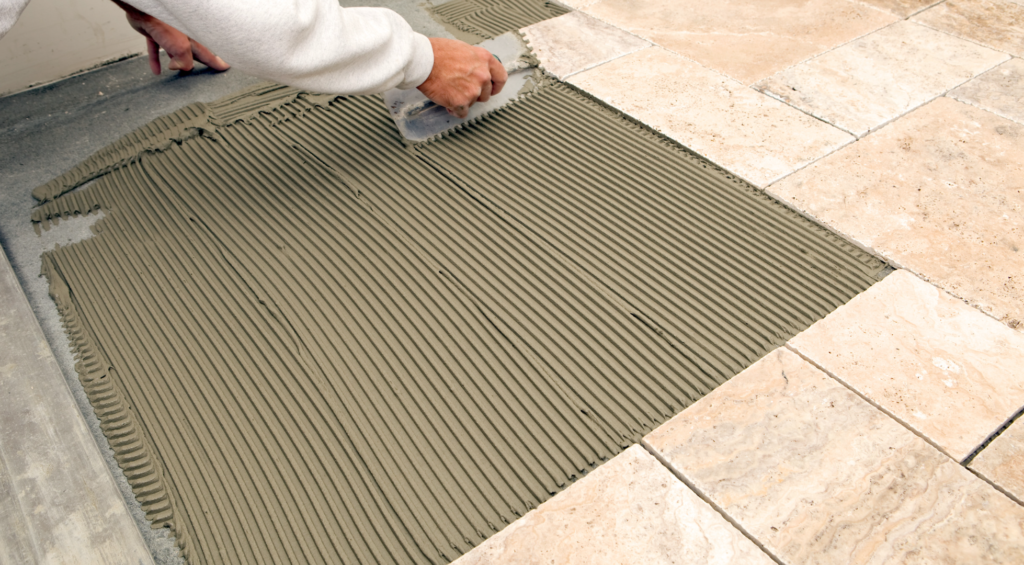
To put 1/64 inch in context: it’s about the thickness of a human hair. Holding that tolerance across a large tile floor requires a perfectly flat substrate, precise mortar application, and a tile leveling system to maintain consistent height between tiles as they’re being set.
How Tile Leveling Systems Work
A tile leveling system is a set of plastic clips and wedges (or threaded caps) that hold adjacent tiles at the same height while the mortar cures beneath them. The clip is inserted under the edge where two tiles meet; the wedge is driven through the clip to create tension that pulls both tiles down to a consistent height. After the mortar sets, the clips snap off at the floor surface and the tabs are removed, leaving a clean, level joint.
These systems were developed specifically to address the challenge of large-format tile — tiles big enough that a skilled installer setting by feel alone can still produce significant lippage. The leveling system takes that variability out of the equation by mechanically enforcing consistent height across the entire floor.
Not all contractors use leveling systems. Budget or low-quality installations often skip them because the clips and wedges add material cost and time. The result is visible in the finished floor — and over time, as grout cracks and tiles shift at the raised edges.
Why This Standard Separates Good Work from Bad
When you’re evaluating tile contractors in Tampa, asking about lippage tolerance and whether they use a leveling system is one of the fastest ways to separate professional-grade work from budget installations. A contractor who can’t tell you their lippage tolerance, or who doesn’t use leveling clips on large-format tile, is telling you something important about the quality of their work.
The 1/64 inch standard isn’t marketing language — it’s a measurable, verifiable result. After installation, you can check it yourself with a straightedge. A quality installer will welcome that check. One who can’t meet the standard will discourage you from looking too closely.
This attention to installation precision is what separates a tile floor that looks great after five years from one that looks like it aged five years in the first twelve months. If you’re investing in porcelain tile — for your bathroom renovation, your kitchen, or your main living areas — the quality of the installation matters as much as the quality of the tile itself.
How to Use This Standard When Hiring a Tile Contractor
Most homeowners don’t know to ask about lippage tolerance before hiring a tile installer. That lack of awareness is exactly why low-quality installations are so common — contractors who cut corners on leveling know that most clients won’t check, and won’t know what to look for if they do.
Asking a contractor directly about their lippage tolerance and installation process is one of the most effective filters available when comparing bids. Here’s how that conversation should go:
Ask about their leveling system. Do they use tile leveling clips on large-format tile? If yes, which system? If they don’t know what you’re talking about, or dismiss the question, that’s a signal about the quality of their work.
Ask about subfloor prep. The most common cause of lippage isn’t installer carelessness during tile setting — it’s an inadequately prepared subfloor that has high and low spots. A contractor who talks about leveling the subfloor before tile goes down understands the process correctly. One who skips straight to talking about the tile itself may be skipping the most important step.
Ask to see examples of their large-format tile work. Photos in a portfolio, a completed project nearby, or even a current job site visit gives you real evidence of their finished quality. Look specifically at the grout lines — are they consistent? — and run your eye across the floor at a low angle to see whether tile edges are flush or slightly raised.
Ask what they do if a tile is out of level after installation. A contractor who has a clear answer — reset the tile before the mortar cures, or grind the edge if the tolerance is just slightly exceeded — understands quality control. A contractor who shrugs or implies it won’t happen may not have a plan when it does.
The investment in quality tile work is significant. Porcelain tile installed in a bathroom, kitchen, or main living area represents thousands of dollars in materials and labor. The difference between a contractor who holds a 1/64 inch tolerance and one who doesn’t is the difference between a floor that looks like a magazine photo for 20 years and one that shows its age in the first two.
If you’re planning tile work as part of a bathroom renovation, our full guide on bathroom remodeling in Tampa covers the full scope of what quality looks like across all the decisions involved — not just the floor.
Frequently Asked Questions
How do I check if my tile floor has too much lippage?
Lay a 10-foot straightedge flat across the floor surface. Any gap between the straightedge and the tile should be no more than 1/8 inch at any point for floors with grout joints under 1/4 inch, according to TCNA standards. For lippage specifically at the tile edges, the allowable height difference between adjacent tiles should be no more than 1/32 inch in standard installations, and 1/64 inch in premium installations.
Can lippage be fixed after tile is installed?
Minor lippage can sometimes be addressed through tile grinding — a process that mechanically reduces the raised edge. This is expensive, time-consuming, and only practical for small areas. Significant lippage across a large floor usually means the tile needs to be removed and reinstalled correctly. This is why getting the installation right the first time matters far more than trying to fix it afterward.
Do all tile sizes require leveling systems?
Leveling systems are most critical for large-format tiles (18×18 inches and larger). Smaller mosaic tiles set in sheets have less individual variation and typically don’t require clip systems. Standard 12×12 tiles fall in the middle — a skilled installer can often set them to acceptable tolerance without clips, but leveling systems still improve consistency. For anything 24×24 or larger, they’re essentially mandatory for professional results.
At Nexus Design, we only recommend what actually works. Our crews install flooring daily across residential projects — we know which materials hold up and which ones fail in high-humidity environments. That field experience is what guides every recommendation we make.